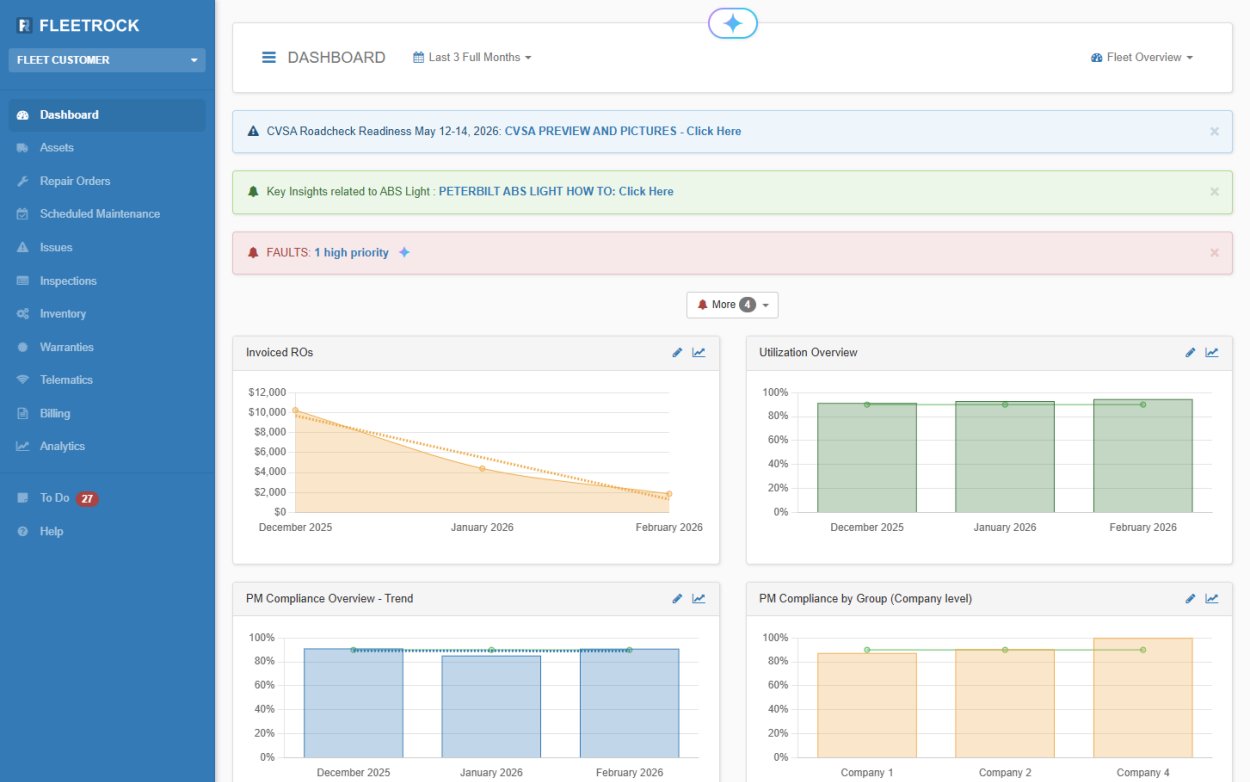
Predictive Maintenance for Fleets: How AI and Failure Data Prevent Breakdowns Before They Happen



Predictive maintenance is no longer just about sensors
Predictive maintenance in fleet operations has traditionally been tied to telematics alerts or basic condition monitoring. But some of the most powerful predictive insight a fleet has already exists inside its own maintenance data. Modern fleet organizations are now using historical repair data to understand:
- when specific parts typically fail
- how those failures relate to odometer and usage
- which failures tend to trigger secondary failures
- and what technicians should inspect while the vehicle is already in the shop
This is where platforms like Fleetrock come in, transforming predictive maintenance from a dashboard concept into an operational decision tool that lives inside the repair process.
What predictive maintenance really means for fleet operations
True predictive maintenance answers three operational questions, and Fleetrock is built to address all three:
- When is a specific component statistically likely to fail?
- If one component fails, what other components are likely to fail next?
- What inspections or preventive work should be performed while the vehicle is already down?
Use odometer and failure history to predict part failures
Most fleets still schedule preventive maintenance around static intervals, but real-world part failures rarely follow clean mileage thresholds. Fleetrock analyzes historical repair activity and models the relationship between:
- the specific parts and systems involved
- the asset class and configuration
- operating usage patterns
- and the odometer reading at the time of failure
By connecting those variables, maintenance teams can identify statistically meaningful failure curves for individual components. Instead of asking whether a unit is simply due for PM, they can ask a sharper question:
"Is this part approaching its most likely failure window?"
That kind of insight lets teams adjust PM intervals by component, target only the high-risk assets, and avoid unnecessary blanket maintenance across the fleet.
Surface predictive insight during the repair order, not after the breakdown
One of the biggest limitations of traditional predictive maintenance is timing. Most analytics live in reports that get reviewed after failures have already happened, when the information can no longer change the outcome. Fleetrock takes a different approach and surfaces predictive failure relationships directly inside the repair order workflow. During a repair event, the platform can expose:
- whether the failed part is commonly followed by other failures
- which related components have a statistically elevated risk
- and how frequently secondary failures occur after the primary failure
That gives maintenance supervisors and technicians critical visibility while the vehicle is already in the shop, not later when the asset is back on the road. The result is fewer repeat failures and fewer return-to-shop events.
Predict part dependencies: when one failure causes another
Many fleet failures are not isolated events. They are part of failure chains, where fixing one component sets the stage for the next problem. Fleetrock uses historical repair relationships to identify part dependencies such as:
- components that fail within a defined mileage window after another component fails
- systems that show strong co-failure patterns
- and failure sequences that repeat across similar assets
For each predicted dependency, the platform calculates a statistical confidence score based on:
- how often the secondary failure occurred
- how quickly it followed the original failure
- and how consistent the pattern is across assets
Together, those factors let teams answer a critical operational question:
If we fix this part today, how likely is another related part to fail next?
AI-guided inspections during repair events

Based on the repair work being performed, Fleetrock's AI can recommend additional inspection points for technicians. As a repair order is created or updated, the system highlights:
- related components with elevated failure probabilit
- known dependency risks
- and historical failure sequences for similar repairs
This lets technicians proactively inspect the right components rather than relying solely on generic inspection checklists. The impact is practical and immediate: fewer post-repair breakdowns, fewer comeback repairs, and higher quality repair outcomes.
Optimize preventive maintenance using real failure behavior
Predictive maintenance should ultimately make the preventive maintenance program itself better. Fleetrock enables organizations to use failure-to-odometer modeling and dependency data to:
- redesign PM intervals by component and system
- create condition-driven inspection rules
- focus PM activity on high-risk parts rather than fixed schedules
- and cut unnecessary PM tasks that do not actually reduce failure risk
This turns PM from a compliance activity into a targeted risk-reduction strategy.
From predictive insight to operational execution
The most important shift is not the analytics themselves. It is where those analytics get applied. Fleetrock operationalizes predictive maintenance by:
- embedding predictions into repair order workflows
- guiding technician inspections in real time
- highlighting secondary failure risk during approvals
- and continuously retraining its models as new repair data is captured
Predictive maintenance becomes part of daily maintenance operations rather than a separate reporting function.
Why predictive maintenance matters for fleet cost and uptime
When predictive insight is applied at the repair event level, fleets can:
- reduce repeat breakdowns
- minimize secondary failures
- shorten unplanned downtime
- improve repair quality
- and lower long-term maintenance cost per asset
Just as important, maintenance teams gain confidence that the work being done today is preventing the failures of tomorrow.